
Iowa School Staffing Trends: Fewer Students, More Non-Teaching Staff
District data from the 1990s to today shows a widening gap between enrollment and staffing—especially outside the classroom.
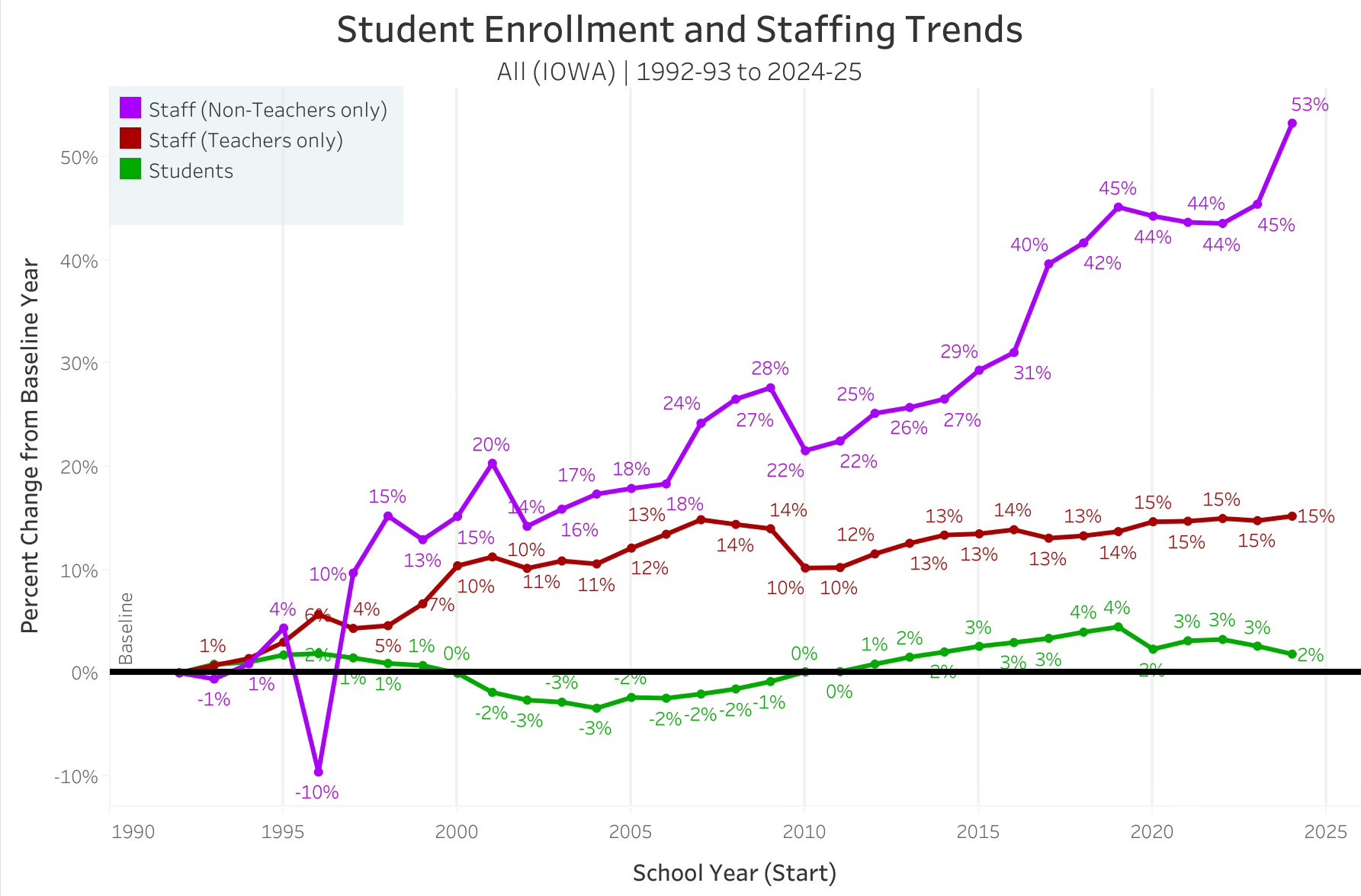
Iowa’s school districts are serving fewer students than they did a generation ago, yet many are employing significantly more non-instructional staff—often 30% to 70% more than in the 1990s. That contrast is not limited to one region or one type of district. It shows up in large districts, mid-sized communities, and even in Iowa’s smallest schools. The outcome looks similar across the board: more staff per student. The reasons, however, are not the same, and understanding those differences is key to understanding what is happening in Iowa’s education system.
A Pattern That Crosses District Lines
Analyzing data from the U.S. Department of Education’s Common Core of Data, covering the early 1990s through today, a consistent pattern emerges across Iowa. In many of the state’s largest districts—Des Moines, Cedar Rapids, Davenport, Sioux City, and Waterloo—enrollment has declined, often by 10% to 25% from peak levels. Teacher counts, however, have remained largely stable. The most significant growth has occurred outside the classroom.
Non-instructional staffing, which includes administrators, instructional coordinators, aides, counselors, and central office personnel, has increased substantially, often by 30% to 70% or more over the same period. As a result, the number of students per staff member has declined by 20% to 40% in many districts, meaning schools today employ far more personnel per student than they did a generation ago. This is not a marginal shift; it is a defining feature of how these systems have evolved.
The Same Direction, Different Contexts
This is not just a large-district story. In mid-sized districts, the pattern is less dramatic but still clearly present. In Bondurant-Farrar, enrollment has grown steadily and teacher staffing has increased in step, but non-instructional staffing has grown faster than both. In Pella, where enrollment has been relatively stable, modest growth in teachers is accompanied by more significant growth outside the classroom. In Boone, where enrollment has been flat or slightly declining, staffing has not contracted accordingly, and non-instructional roles have continued to expand.
Across different types of districts—whether growing, stable, or slightly declining—the direction is the same: non-instructional staffing tends to increase faster than student enrollment. That consistency makes it difficult to dismiss this as a localized or temporary phenomenon.
Why This Is Happening
There is no single explanation for this pattern, but several structural factors likely contribute. Categorical funding streams often support specific programs and positions, encouraging additions without requiring reductions elsewhere. State and federal mandates have expanded compliance, reporting, and service requirements. Over time, districts may also add layers of staffing in response to new expectations without a corresponding mechanism to scale back when student counts fall.
Individually, each of these factors may be understandable. Together, they produce a system in which staffing growth is no longer tightly linked to enrollment, particularly outside the classroom.
Where Growth Does Align
There are exceptions, and they are important. In fast-growing districts like Ankeny and Waukee, enrollment has increased dramatically over the past two decades. In those districts, staffing has grown as well, with teachers increasing alongside student enrollment and support staff expanding largely in proportion to that growth.
Student-to-staff ratios in these districts remain relatively stable, reflecting a system that is scaling to meet demand rather than expanding independently of it. This provides a clear contrast with districts where staffing continues to grow despite flat or declining enrollment.
Why Small Districts Look Similar—but Aren’t
It is also important not to misapply this critique to Iowa’s smallest districts. In places like Albert City–Truesdale or Clay Central–Everly, enrollment has declined sharply—often by 40% to 60% or more—and staffing has declined as well, but only to a point. Schools must maintain a minimum number of teachers, administrators, and support staff to function.
In even smaller districts such as Bennett, Diagonal, or Orient-Macksburg, enrollment can fall to very low levels, but staffing cannot fall below a functional floor. In these cases, higher staff-to-student ratios are not the result of expansion but basic operational limits. The appearance may be similar, but the underlying cause is fundamentally different.
A Statewide Structural Shift
Taken together, the data points to a clear statewide pattern. In large districts, enrollment declines while non-instructional staffing grows. In mid-sized districts, staffing grows faster than enrollment even when enrollment is stable or increasing. In small districts, staffing cannot decline enough to match enrollment losses.
Different causes, same outcome. Across Iowa, districts of every size are ending up with more staff per student over time. That consistency suggests this is not simply a series of local decisions but a broader structural shift in how schools are staffed.
The Question Going Forward
This is not an argument against public education, nor is it a claim that every non-instructional role is unnecessary. Schools today face real challenges, and many require support beyond the classroom. It is, however, an argument for paying closer attention to how the system is changing.
In many districts, staffing growth—particularly outside the classroom—is no longer tightly connected to student enrollment. That shift may reflect evolving expectations or policy decisions, but it is not neutral. When enrollment falls or remains flat and staffing continues to grow, especially in non-classroom roles, the system is making choices about priorities.
Across Iowa, the outcome is consistent: more staff per student. In many districts, however, that outcome is not being driven by more students but by the expansion of the system itself. When enrollment falls and non-classroom staffing rises, the system is no longer simply adapting—it is sustaining structures that have grown over time. That is not just a question worth asking; it is a reality that deserves to be confronted.


